
Latest Post

Manila’s Airport is a Crime Against Humanity

AS I mentioned in the previous post, I have a bit of a problem with the Ninoy Aquino International Airport (NAIA), the main airport of Manil...

Manila’s Airport is a Crime Against Humanity

AS I mentioned in the previous post, I have a bit of a problem with the Ninoy Aquino International Airport (NAIA), the main airport of Manila, and the Philippines’ primary international gateway. Let’s talk about that, starting with my Manila Times column from Sunday, Dec. 14:

Hell on our doorstep

Rough Trade, Dec. 14, 2025

I hate Ninoy Aquino International Airport (NAIA). I hate it with the fire of 1,000 suns. There is a word in my native dialect that we use to describe places such as NAIA, which begins with the letters “shi-” and ends with the letters “-thole.” I used to refer to NAIA, which is routinely adjudged one of the World’s Worst Airports on every annual list of such things, as “Asia’s LaGuardia,” after the famously bad airport in New York City, but I’ve had to change that tune. Henceforth, every terrible airport everywhere else will be known as “(name of country’s) NAIA.”

I put the blame for this squarely in the lap of the San Miguel Corp. (SMC)-led New NAIA Infrastructure Corporation (NNIC), which took over operation of the airport on September 14 of last year. Prior to that date, NAIA was merely awful; now it is completely horrifying. I spent a few days of much-needed rest in my favorite getaway spot in Palawan over the recent long holiday weekend, which was a wonderfully therapeutic and soul-refreshing experience. Having that bookended by the vile tragedy of having to depart from and return to NAIA was most unfortunate, to say the least.

On this particular flight, I was consigned to using Terminal 3, and this is what that experience was like: Arriving at the airport early Saturday morning (Dec. 6) was typically chaotic, with a great deal of traffic at the departure curb, but that is to be expected. However, the persecution really begins once one steps into the terminal, and is confronted by an apparent recent “upgrade” that requires every passenger to print his or her own luggage tags at a computerized kiosk. This machine is not exactly user-friendly, nor are the few cheerless airport personnel in the vicinity, whose only helpful instruction to anyone not familiar with the routine is, “well, you have to fall in line.” And then fall in line again to actually hand your bags over. So in essence, this particular innovation which I guess some genius thought would make things more efficient simply adds a pointless extra line and process step.

After physically dropping off one’s bags, it is then necessary to wade through the crowd in front of the check-in counters in order to move toward the security check. It has always been like this in Terminal 3, and one would think that correcting the flow of foot traffic would have been an easy, low-cost fix for the experts working for a company run by “Mr. Infrastructure,” but one would apparently be wrong on that.

Somewhere in between the tangle of people in the check-in area and the security checkpoint leading to the departure, one should be able to visit the brand-new Food Hall located in the Terminal 3 mezzanine, which opened with much fanfare just this past October. How does one reach this new feature? Beats the hell out of me; there are no signs pointing the way, and the two escalators leading in that direction are non-functioning and barricaded. There are some food and other outlets in the concourse, but since it is dreadfully overcrowded – a consequence of the poor design of the terminal, aggravated by large areas being blocked off for construction work – they are only appealing to those who are desperately hungry or thirsty. I have a favorite spot for an arrival breakfast in Puerto Princesa, so I could suck it up and go stand by the gate (stand, because there is about one-tenth the number of seats needed for waiting passengers) for the relatively short time until my flight was ready for boarding.

Getting away from NAIA was bad enough; returning to it was an absolute nightmare. First, there is exactly one (1) rest room each available for men and ladies in the baggage claim area, so that one’s discomfort at having to walk the entire length of the arrival concourse and ride down an escalator to reach the facilities is enhanced by having to wait in a long line of similarly uncomfortable arriving passengers.

Second, the system for organizing arriving luggage is apparently random. Although there was an information sign indicating that a couple of flights were to be unloading at one carousel, neither of those were at that carousel, whereas mine (which never appeared on any of the signs) was. I think this is an airport thing rather than a Terminal 3 thing; my previous return flight a few months ago docked at Terminal 2, and the same thing happened there, although in that case there was at least a helpful Philippine Airlines employee on hand to point passengers in the right direction.

Finally, escaping the airport has become damned near impossible, unless one has parked his or her own car there, which I did not. The pick-up location for all of the ride-hailing services such as Grab have been relocated to the parking garage at the far end of Terminal 3, rather than being along a lane in front of the departure area like every other normal airport in the world. As a consequence, unless one is willing to pay the extortion fares charged by the official “airport metered taxis,” or resort to the car-hire desk (which is where I ended up) at a rate five or six times what it ordinarily costs, one will be able to exit the airport and return home approximately never. As a Grab driver I spoke to on Friday explained, dropping passengers at the airport is no problem, but picking them up is loathsome and to be avoided at all costs, due to the new “system.”

The image NAIA gives the Philippines as a whole in the minds of visitors has been long-lamented, but incredibly, the new management of the airport has found a way to tunnel under that already low bar. Last week, Sen. Erwin Tulfo made an appeal for the reduction of domestic airfares to attract more travelers; I think one way that partial fare relief could be implemented would be for the government to tell NNIC to take its increased terminal fee at NAIA and shove it somewhere, until it demonstrates that it can actually provide passengers some value to justify it. As it stands now, everyone is paying more for an experience that is not just a downgrade from its already poor previous level, but an atrocity.

***

Some additional context and insights, beginning with the name of the airport. Senator Benigno “Ninoy” Aquino was the exiled opposition figurehead in the time of the dictatorship of Ferdinand Marcos Sr., and who was famously assassinated at the airport about five minutes after his return to the country in August 1983. Just because that was a historically significant moment for the country (it would eventually lead to Marcos’ ouster, almost three years later) doesn’t mean that “let’s honor a political and cultural icon by naming the airport where he got smoked after him” was a good idea; to my mind, that probably brought some kind of curse to the place. Particularly in the somewhat ghoulish way that “honor” was expressed; for a while, there was a replica chalk outline of Aquino’s corpse in a little shrine inside Terminal 1 (the main international terminal) of the airport, and as far as I know, the spot on the apron outside Gate 11 where he got his head blown open still has a memorial plaque set in the pavement.

NNIC is part of the conglomerate controlled by uber-tycoon Ramon S. Ang; San Miguel Corporation’s core business is booze, but it’s also heavily involved in foods, energy, and infrastructure, among other things. A couple of years ago, I called out SMC for a shitty plan it had to build an elevated toll road above the Pasig River, which cuts through Metro Manila from east to west. That project was immediately targeted by protests by anyone in the city with half a brain in their heads; I did a little digging, and found out that the company had sort of fraudulently acquired environmental clearance. Thus, Mr. Ang (no relation to my adopted family who owns the paper I work for) and his entire organization pretty much despise me. I was savagely attacked after the piece on the expressway, and I expected to be after this one about the airport, but the reaction this time was surprisingly mild and indirect. In fact, the immediate reaction (which came the day after my column was published) was a self-congratulatory press release from SMC about how well construction of its New Manila International Airport north of the city is progressing. Then later in the week, Ang was on hand, along with President Ferdinand R. Marcos Jr., at NAIA to inaugurate a new digital immigration processing system in Terminal 3, something which is rather the least of the concerns about that shithole.

Apart from the new airport, which will probably not be operational for another 8 to 10 years anyway, there are only 3 substantial airports in the country that are privately operated: NAIA, the Cebu-Mactan International Airport, and Clark International Airport, the old US Clark Air Force Base on the outskirts of Angeles City in Pampanga, about 85 kilometers north of Manila. Cebu is a decent airport and seems well-run, and so is Clark; it is only NAIA, the only one run by an SMC subsidiary, that has problems. Ironically, the 44 government-owned airports run by the Civil Aviation Authority of the Philippines (CAAP), while certainly not fancy, are clean, efficient, and pleasant to travel through.

Trip Report: Palawan (again)

BETWEEN December 6 and December 10, or a little over a week ago as I write this, I was fortunate enough to find myself in good company once again in my favorite place on the planet, the island of Palawan in the Philippines. Or specifically, the northern town of San Vicente, which lies about two-thirds of the way between the main city of Puerto Princesa and the famed (and in my opinion, positively awful) resort area of El Nido. Or even more specifically, the outlying tiny barangay (village) of San Vicente known as Alimanguan (the word alimango in the local language means “crab”). There, along a long stretch of San Vicente’s moderately famous 15-kilometer beach, you will find the Victoria Beach House, operated by the affable and accommodating Mr. and Mrs. Ferdinand and Mylene Victoria and their cheerful staff.


It is hard for me to find enough superlatives to describe how much I love this place. Simple, comfortable, with good home-cooked food, and in a lovely, uncrowded setting on the best beach you could hope for, there is just something about the place that immediately drains the stress from one’s body. There is not much to do there, but that is exactly the point: Rest, recover, and let the slow vibe of the place and its neighboring village set you right. For those who are looking for some activities, the Victorias do offer a number of tours and outings, but most guests – a surprising number of which find their way here after being turned off by the high prices and tourist crush in hectic El Nido – seem content to do what I do, which is to shut down and soak it up. If one does have to get a little work done (which I did while I was there), it is the world’s best office space.

On this particular trip, I had the memorable experience of seeing an Olive Ridley sea turtle pick a spot next to the resort’s common area to make her nest. I wrote about this, and the locals’ unique respect and DIY conservation efforts for the turtles, in my Manila Times column on Thursday, Dec. 11:

“What impressed me, after I got over the little-kid LOOK AT THIS TURTLE reaction, was that the local people here are extraordinarily protective of them. The turtle had picked an inconvenient spot, halfway under the outrigger of a beached banca along a pathway between the beach and the road, where if left alone the nest would either be trodden on by unaware tourists or dug up by the stray dogs. So, after standing guard to make sure that the handful of us gawking visitors gave Mrs. Turtle some space and didn’t spook her, the staff here continued to keep watch until she finished her business and made it safely back to the water, then carefully excavated the nest and relocated it to a spot where it would be safe and could be monitored. Provided all the eggs develop properly, in about two months’ time 96 hatchlings will emerge and make their way to the sea, with the locals again assisting by clearing a safe path for them.

I learned that the municipality of San Vicente does have an ordinance protecting the sea turtles, which is intended to complement national and provincial conservation laws and regulations. In reality, however, the people here do not seem to need a law; the turtles are considered a harbinger of good fortune, and having one’s property ‘chosen’ as a nesting site is an extraordinary blessing.”

Getting There

There are a few different ways to reach San Vicente, but the most efficient and comfortable – and all things considered, probably the most economical – is to arrange for pickup at Puerto Princesa Airport by the Victorias, who have several vehicles fit for the purpose. One-way fare is P4,500, or about $76, but since it’s a private ride, you can make stops and detours along the way as you wish. Our usual routine is to take an early flight from Manila (the Manila airport is pure hell, which will be the subject of a subsequent post, I don’t want to ruin the happy tone of this one), which takes about an hour, and then proceed to my favorite coffee and breakfast spot in Puerto Princesa, Lato, which is located along the Baywalk. This is some of the best coffee in town (although the competition is fierce, as noted below), and features simple, tasty homestyle breakfast. My total tab for breakfast and coffee for three people came to P830, or about $14.

Then it’s on to the road north, which is a pleasant, three-and-a-half hour ride, including a couple of brief stops along the way. The road is quite good by Philippine standards, although there were spots that had been damaged by landslides caused by recent typhoons. Palawan is essentially one long mountain ridge, with most habitation and infrastructure along the narrow space between the mountains and the sea; it makes for a spectacular landscape, but one that can be a little challenging.

For the return trip, it is highly recommended to travel back to Puerto Princesa the day before your return flight to Manila. Going directly to the airport from San Vicente could be a bit risky, and spending the night in Puerto Princesa offers a few pleasant diversions, as the city itself is quite interesting.

Puerto Princesa Finds

This latest trip ended at the Fersal Hotel, a surprisingly well-appointed and affordable hotel located on the opposite side of the airport. It has nice, spacious rooms and offers free breakfast as well as airport transfer, which took all of about 10 minutes.

On a side note, compared to the Ninoy Aquino International Airport in Manila, the Puerto Princesa Airport is a nice, trouble-free facility. That, too, will be a topic for another time.

If you stay at the Fersal Hotel, I would recommend asking for a room toward the rear of the building. It sits directly across the road from a couple of local bars, which are noisy until the wee hours of the morning.

Just a couple of blocks down Rizal Ave. from the Fersal Hotel in the direction of downtown is the Kapì Coffee House, a pleasant little shop offering some very good local coffee. Palawan in general and Puerto Princesa specifically stands out among Philippine coffee hotspots, in spite of the fact that the coffee from the far north and far south of the country is much better known, so it is difficult to say one of the many, many coffee shops in the city is better than another (though Lato is still my favorite). If you come here and end up at Starbucks, you’re an idiot, frankly.

After a quick stop at a familiar spot to find local handicrafts, Asiano Arts & Crafts, it was time to eat. Dinner choices abound in the city, although from the Fersal a short ride toward the downtown area is required. Puerto Princesa is known for Vietnamese food; a great many refugees fleeing Vietnam at the fall of Saigon in 1975 settled in Puerto Princesa, adding a unique (and well-appreciated by the natives) bit of culture to the town. We discovered a different sort of gem near the Baywalk, however, in Fatima Halal Food, a cozy hole-in-the-wall offering first-rate South Asian dishes. I delight in Indian (and Indian-ish) food, so I am a tough critic, but this place felt and tasted like eating at someone’s mom’s house, which is about the highest praise I can offer. The portions appear small at first, but they are precisely just right; two of us left satisfied, and all for the princely sum of P435, or about $7.38.

Finally, a short ten-minute walk (interrupted by a brief downpour) brought us to the city destination I had been targeting since well before leaving for Palawan, the Palaweño Brewery. Craft breweries have begun to catch on in the Philippines in recent years – for example, a very good recently opened alongside the park about two blocks from my apartment – but as far as I know, Palaweño was one of the first, if not the first, and probably the only one whose founders and proprietors are women. The beer is excellent, it goes without saying, and I sampled several varieties before adding considerable bulk to my luggage by buying a six-pack sampler to bring home.

See for yourself

Victoria Beach House: https://www.facebook.com/victoriabeachhouse.palawan/

Lato Puerto Princesa: https://web.facebook.com/LatoSaBaybay/

Fersal Hotel: https://fersalhotel.com/fersal-hotel-puerto-princesa-city-palawan/

Kapì Coffee House: https://web.facebook.com/kapipalawan/

Asiano Arts & Crafts: https://web.facebook.com/AsianoArtsCrafts/

Palaweño Brewery: https://www.palawenobrewery.com/

Photo Gallery

Sunrise from 33,000 feet over the South China Sea.


Along the Puerto Princesa Baywalk.


The breakfast of champions at Lato.


Home away from home, San Vicente, Palawan.


Some beach scenes. This shallow cave is in the rock seen in the photo farther down, accessible at low tide. 


Not a bad workspace. 


This absolute unit is from the neighborhood, and his name is Max, because of course it is. He has a female counterpart almost the same size as he is (which is VERY LARGE), as well as a ridiculously out-of-scale Jack Russell housemate. Max is a Kangal, a native Turkish herd and guard dog. He seemed to like me, which is good, because I have no doubt he could have taken my arm off if he wanted to. 


I call this the "Hillbilly Mai Tai" -- Maker's Mark bourbon and fresh coconut juice. Hey, I gotta be me. 


LOOK AT THIS TURTLE. LOOK AT IT. This was a young Olive Ridley female (they are fairly common in this part of the world), the knowledgeable locals thought this might have only been her first or second nesting. We goober tourists were instructed not to put a light on her until she actually started releasing her eggs, so as not to scare her.


The nest was carefully relocated to the dining area of the resort and appropriately protected. The turtle hatchlings will emerge sometime during the second week of February. 


A sign in the Fersal Hotel's elevator advertising its Karaoke lounge. When I shared the photo with my daughter back home, she said, "I don't think that's how it's supposed to work." Heh. 


The accommodations at the Fersal Hotel are quite comfortable.


Yes, the name of this shop is literally "Coffee Coffee House." I found it quite good. 


I did not really get a good photo inside the Asiano Arts & Crafts shop, partly because my daughter decided to do some online shopping for little Christmas gifts over my WhatsApp. It is definitely worth a visit. 


Don't blink or you'll miss it, and if you do, you will profoundly regret it. I am definitely going back here. 


Getting caught in a thundershower was a small price to pay to find this place. 


See you again soon, Palawan. 


The Key Figure in the Philippines' Public Works Corruption Scandal

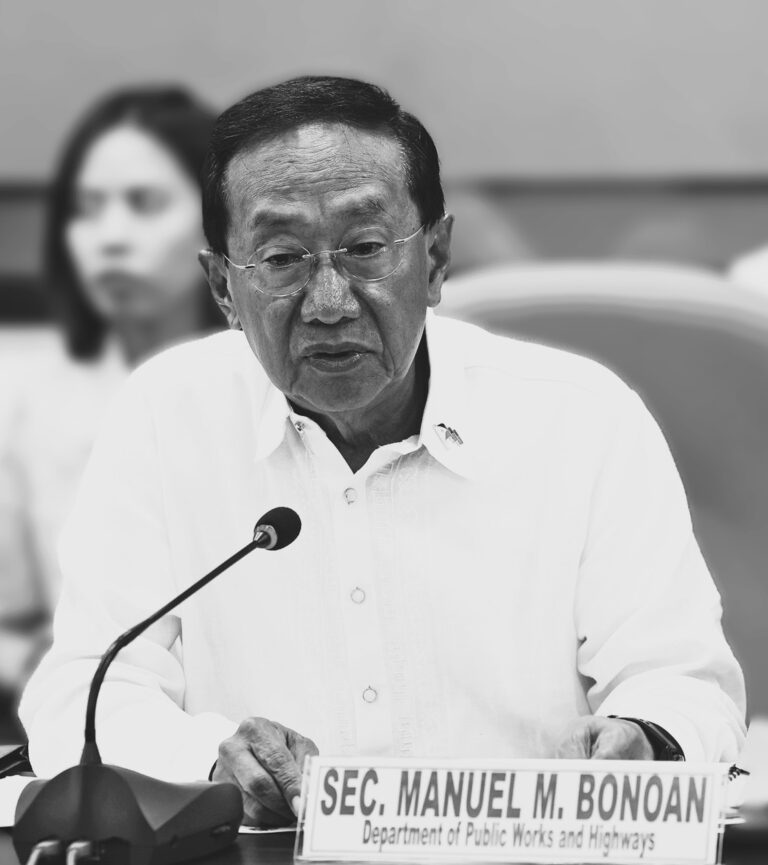
WHAT follows below is my two-part column from Tuesday, Nov. 11 and Thursday, Nov. 13 in The Manila Times, which is about an old case involving the Department of Public Works and Highways (DPWH) in the Philippines and massive corruption that was discovered in a World Bank-funded highway project in the early 2000's. This guy (pictured) is former DPWH Secretary Manuel Bonoan, who resigned in disgrace on Sept. 1 in the wake of revelations about massive corruption involving flood-control projects under the DPWH.

On the same day that the first part of this column was published, Tuesday, Nov. 11, Bonoan, who was already tagged for investigation by the government in the more recent scandal, fled the country for "medical treatment" in the US, which is what corrupt government officials here in the Philippines do to try to avoid questioning or prosecution. 

The reason I am posting this now is that there was a development concerning this individual earlier this evening (Saturday, Nov. 29). I am not able to divulge details of that, because that is confidential business, but because what happened a) mortally offended me, both for my own sake and for the good of my organization, b) was just completely fucking wrong on moral, ethical, and common sense grounds, and c) proved that I was absolutely right in what I wrote or implied in the columns that follow (and thank you to my perceptive daughter for instantly realizing that and pointing it out), this story needs to get out there. Believe me, there are a HELL of a lot of details I have that I didn't air out publicly; you want to try me, you crooked bastard, go right ahead, and see how that works out for you. The development (that's a mild word for it, but I'll stick with that for now) this evening was so infuriating and so offensive that I have now taken a personal interest in seeing you suffer, jackass. And the individual who passed it along (not saying who that was, yet, but you know who you are) better watch out, too. I didn't want to get involved too much in this whole corruption mess, but guess what, now I am. May whatever God you subscribe to have mercy on you, because I will not. 

***

The skeleton in Bonoan’s closet

Ben Kritz

Rough Trade

First of two parts (Tuesday, Nov. 11, 2025).


LAST week, the Independent Commission on Infrastructure (ICI), which is beginning to look a lot less like an investigative star chamber and more like a major cog in a complicated damage-control machine, made a recommendation to the Ombudsman that former Dept. of Public Works and Highways (DPWH) secretary Manuel M. Bonoan, along with two former undersecretaries, be investigated for possible violations of the Code of Conduct and Ethical Standards for Public Officials and Employees. This is in connection with one of the literally hundreds of flood-control projects that have so far been discovered to have been fatally compromised by graft, in this case a P72.6-million project in Plaridel, Bulacan.

The complaint, or recommendation, or FYI, or whatever it actually is that has been passed from the ICI to the Ombudsman’s office seems quite sketchy, at least as it has been reported in the news. The project itself is described as being illicit not because it wasn’t built, but because it was built somewhere other than it was supposed to be, which is just weird. That’s one clue that an organized whitewash may be underway.

A second clue is that the ICI seems to have specified that the Ombudsman look into violations of the Code of Conduct and Ethical Standards, which is serious but not the same kind of dire crime that is represented by a violation of the Graft and Corrupt Practices Act, which is what is automatically implied – at least where public officials are concerned – in every one of these cases. A “recommendation” that would have raised far less public suspicion would have been for the ICI to simply inform the Ombudsman, “Here is our information, which we believe indicates illegal acts may have occurred. Please figure out which ones, if any, and proceed accordingly.” After all, that is kind of the Ombudsman’s job.

The third clue is the skeleton in Manny Bonoan’s closet with regard to the DPWH, or more specifically, not that the skeleton is there, but the way it was handled, or not handled, as the case may be.

Back in the early 2000s, World Bank funded a road improvement project here in the Philippines called the National Roads Improvement and Management Program, or NRIMP. The total project, which was originally scheduled to run from 2000 to 2009, had a total price tag of $2 billion; Phase One of the project involved a $150 million loan to the government from World Bank, with $133.2 million of that being disbursed by the loan closing date in March, 2007.

For the sake of accuracy, I will quote directly from the public version of the World Bank integrity report:
“In April 2003, INT [i.e., the Integrity Vice Presidency] was informed by the Bank team supervising the Project that the procurement process relating to the award of two NRIMP-1 contracts (the NRIMP-1 Contracts) might have been tainted by fraud and corruption. Those Contracts, with a combined estimated value of approximately P1.88 billion (US$33 million), were for the rehabilitation of parts of the Surigao-Davao Coastal Road [in Mindanao], the Kabankalan-Basay Road [in Negros], and the San Enrique-Vallehermoso Road [also in Negros]. Bank staff had determined that the results of the 2001-2002 bid process showed indications of collusion, most notably the questionable disqualification of some of the potential bidders and abnormally high bid prices. The Bank’s task team accordingly declined to issue a letter of no objection to the results of this first round, asked DPWH to re-bid, and referred the matter to INT. Finding the bid prices still unjustifiably high after the 2004 re-bid, the Bank asked DPWH to carry out a third round of bidding. The Bank ultimately decided not to provide a no-objection letter a third time, for the same reason, in 2006. The contracts were not awarded under the NRIMP project.”

To summarize what the World Bank team discovered, a well-organized cartel of DPWH officials, politicians, and foreign and domestic contractors pre-selected winning bidders for construction contracts, who bid inflated prices to cover the subsequent bribe payments, including compensation to the losing bidders, who were coached ahead of time on how much they should inflate their bids to make it look like as though the process was legitimately selecting the lowest bidders. Prospective bidders who did not cooperate would be frozen out from any future DPWH bidding.

As a result of this investigation, World Bank informed the Department of Finance and the Office of the Ombudsman in 2006 even before it was finished, and then formally turned over its complete findings in 2007. That report presumably included names of those involved, although for the sake of not compromising any criminal or administrative investigation, those are not included in the public version of the report. For its part, World Bank “blacklisted” seven companies and one individual from participating in any World Bank-backed projects for periods ranging from seven years to infinity. Since some of those sanctioned were based in China, it also shared it report with Chinese government, to support whatever action it might want to take against its own people.

So where does Manny Bonoan fit into all this? Stay tuned for Part 2 on Thursday.


Second of two parts. (Thursday, Nov. 13, 2025)


FORMER Department of Public Works and Highways (DPWH) Sec. Manuel M. Bonoan was named along with several others by the Independent Commission on Infrastructure (ICI) in a recommendation to the Ombudsman that the latter investigate possible illicit actions related to a P72.6-million flood control project, as was widely reported in the news. That Bonoan’s name would come up should not come as a surprise; he was, after all, in a position as DPWH secretary to know about any corrupt activities within his department. Questions about whether he actually did or not, and whether he had any involvement in them are unavoidable.

When he was appointed as DPWH secretary by President Ferdinand R. Marcos Jr. on June 30, 2022 – one of the first cabinet appointments the then-newly inaugurated president made – Bonoan began his second stint with the department, adding to a career that might be record-breaking in terms of its longevity. Bonoan first started working for what was then known as the Bureau of Highways in 1967, when he was still a senior in college. The 22-year-old civil engineering aide would become a sort of poster child for the DPWH, working his way up from that lowest spot on the totem pole to become an Assistant Secretary for Planning by 1987, and then being advanced to the rank of Undersecretary in 1994.

In 2000, just about the time the first phase of the World Bank-backed National Roads Improvement and Management Program (NRIMP) project was getting underway with the DPWH as the implementing agency, Bonoan was named Senior Undersecretary and made chairman of the Pre-qualification, Bids, and Awards Committee (PBAC) for Construction Projects in the Visayas and Mindanao. As explained in the first part of this column on Tuesday, World Bank later discovered that bidding and awarding of construction contracts for one component of the NRIMP, involving one road project in Mindanao and two in Negros, had been controlled by a cartel involving DPWH officials, politicians, and cooperating contractors. The ensuing investigation by World Bank’s Integrity Vice Presidency group eventually led to World Bank blacklisting seven companies and one individual, and passing its report on to the Department of Finance and the Office of the Ombudsman.

The World Bank team discovered the collusion in the results of the bidding for several contracts for work on these three highways in 2001-2002, and “declined to issue a letter of no objection.” The normal process on these types of projects being funded by World Bank or similar institutions is for bidding and awards to be carried out by the implementing agency, and then reviewed by the bank, which is sensible since the bank is one the ultimately paying for it. Normally this is a routine procedure that results in the contracts being cleared to proceed, but it wasn’t in this case. World Bank asked DPWH to conduct the bidding again, which happened in 2004, but incredibly, the same indications of collusion in the bidding were evident the second time, so again World Bank objected. A third round of bidding ensued in 2006 with the same results, at which point World Bank – which by now had already notified the DOF and Ombudsman of its investigation – put a stop to the shenanigans, withholding about $33 million of the initial $150 million loan and thus preventing these contracts from being awarded.

As senior undersecretary and chair of the PBAC for Visayas and Mindanao, Bonoan would have certainly known about the cartel, and may have even been a part of it, although the public version of the World Bank integrity report does not name anyone involved, so as not to compromise any investigative action the government might want to take. It is also not clear whether or not Bonoan’s PBAC was responsible for conducting the bidding on the NRIMP projects; they certainly did fall within his normal jurisdiction, but subsequent parts of the NRIMP project, which were implemented after 2011, used a Special Bids and Awards Committee (SBAC), which might also have been the case in 2001-2006.

Nevertheless, in his particular position as a senior undersecretary with oversight on projects in the Visayas and Mindanao, and with more than 30 years’ experience in the DPWH at that point, there is simply no way that Bonoan, if he was not involved personally, could not have known what was happening with the ‘cartel’ that had been uncovered. That he – or to be fair, no one else in DPWH – did nothing to stop it is obvious from that astonishing fact that even after the DPWH knew World Bank’s integrity people were on to them, the same sort of rigged bidding was carried out again, not once but twice.

And what did the government do about this discovery of organized corruption within DPWH? Apparently nothing; there is no record of any significant investigative or legal action being taken on the matter, and while Sen. Loren Legarda filed a resolution calling for an investigation in the Senate in early 2009, that seems to have come to naught as well. For Bonoan’s part, he was temporarily promoted to officer-in-charge of the DPWH between February and July 2007, filling in for Hermogenes Ebdane Jr., who served a short stint during that time as Defense Secretary. Bonoan eventually retired from DPWH in 2010, right about the time Rogelio Singson –now a member of the ICI – was named secretary by then-president Aquino, and went on to the private sector, until being recalled by President Marcos in 2022. Bonoan’s still-unanswered role in the NRIMP scandal in his previous stint at DPWH was evidently not considered important either by the president or the Commission on Appointments.

Unfortunately for Bonoan, his position at DPWH, both between 2000 and 2007 and from July 2022 until his resignation under a cloud of controversy in August of this year, requires that his guilt or innocence in either scandal be explicitly established. “Presumption of innocence” in the form of just ignoring the open questions is not good enough, especially not with public faith in the government deteriorating as rapidly as it is. Releasing the confidential version of World Bank’s 2007 report would be the right step. The government, however, appears increasingly reluctant to take right steps, so we shall see what happens.

ben.kritz@manilatimes.net
Bluesky: @benkritz.bsky.social


Movie Review: ‘Wicked: For Good’ is a complete mess

A couple of disclosures are probably necessary to put this review into some kind of context. First, even as a child I was never a fan of the “Wonderful Wizard of Oz,” the L. Frank Baum novel that was adapted into the immortal 1939 film starring Judy Garland. The story (in either book or movie form) was too simplistic, too shallow in its black-and-white moral lesson about good and evil even for 5- or 6-year-old me. What can I say, I was a precocious kid, and in kind of a troubling sort of way. Ask my mom.

Nevertheless, I’ve always respected the original works (book and movie) as important artifacts of human culture. You don’t have to like the Mona Lisa as a painting (it’s small, and kind of dull when you see it in person), but you have to acknowledge its bigger-than-life importance. Same goes for the Wizard of Oz; it’s that realization that helps one endure seeing the damn movie over and over and over and over again for a period of 5-6 months when one has toddlers in the house. Goddamn, am I glad my kids have grown.

Second, and I realize I am a bit of spoilsport with my attitude, but when it comes to films that are iconic pieces of culture – whether I enjoy them or not – I feel very strongly that they should be left well enough alone, and not be “reimagined” or otherwise redone by others who either lack imagination to come up with something original, or have only just enough imagination to realize they can cash in with something vaguely related to the iconic original. There are exceptions, but they are exceedingly rare. “Wicked: For Good” is not one of them.

The film is the second of two movies adapted from the hit Broadway musical “Wicked,” and the fact that they milked it for two movies when one would do (the original musical was two-and-a-half hours long, with a 15-20 minute intermission) tells you all you need to know about the creators’ real motives. And to be fair to them, it absolutely seems to be working; according to news reports, the movie made something like $226 million over its opening weekend, putting it on par with The Minecraft Movie in terms of popularity.

Sweet Jesus, send the goddamn meteor already.

The first installment of this awkward attempt at retconning the Wizard of Oz, 2024’s “Wicked,” was clumsy, a mule-footed antifascism sermon projected through a filter of CGI so heavy the whole thing felt like a peyote dream. But at least it ended, confusing as its message was: Elphaba (played by Cynthia Erivo) became the Wicked Witch of the West, giving the bumbling dictator The Wizard (played by Jeff Goldblum) and his public cheerleader, the vacuous Glinda (played by Ariana Grande) the villain the Wizard’s fearmongering authoritarian regime needed. So... that was good? Maybe? Who knows. But it was done, and collected its mountain of cash, and the world could move on.

However, director Jon M. Chu and screenwriters Winnie Holzman and Dana Fox said “hold all our beers,” and took everything that was cringe-inducing and overblown about the first film and dialed it up to 11 for this second one. As far as I could tell, apart from being a naked money grab, the main purpose of “Wicked: For Good” from a storytelling perspective was to fill a plot hole no one except people who still write on Tumblr would care about, tying the “reimagined origin story” of “Wicked” to the 1939 classic film. That happened about three-quarters of the way through “Wicked: For Good,” at which point I let out an involuntary groan and said, “Please don’t tell me we now have to sit through the entire Wizard of Oz, god, will this never end?”

Before that happened, however, the audience was treated to an assault on their sensibilities, through a plot of interpersonal drama that would put most soap operas to shame. Oz the World Turns. Glinda’s fiancĂ©, the dashing Prince Fiyero (Jonathan Bailey), jilts her at the altar to run off with his crush, Elphaba; in her forest lair, fully consumed by jungle fever, he tells her he finds her beautiful because “he’s seeing things in a different way.” The origin stories of the source materials’ Tin Man, Cowardly Lion, and Scarecrow are fleshed out in rather gruesome ways – without giving too much away, the Tin Man and Scarecrow are the results of the epidemic of love triangles happening, while the Cowardly Lion is a metaphor for, as near as I could tell, the old Southern ideal of the “happy slave.”

Bigotry and racism are in fact key elements of the story throughout. The Wizard’s regime regards animals, who are smart and can talk and do important jobs (i.e., just like non-white immigrants in America, or, if you really want to go there, Jews in Germany), with suspicion, and first marginalizes them, and then either seeks to imprison or drive them out. People with disabilities, represented by Elphaba’s wheelchair-bound sister Nessarose (played by Marissa Bode), she of the ruby slippers that the OG Dorothy ends up wearing, are bitter and helpless. The dictator of this goofy world, The Wizard, is a bumbling hick who stumbled into his position, but has great power at his disposal so everyone is careful to praise him (sound like anyone we know?), which is made all the more easy by the general population being a herd of dumb sheep. And of course, there is the real power behind the throne, the conniving, brilliantly evil Asian lady, who, just in case the caricature is too subtle, is given the name Madame Morrible; she is played by Michelle Yeoh, who, except perhaps for Goldblum, has more acting talent in her left tit than the rest of this cast has put together, though that is somewhat diminished by her costume featuring a hairstyle that looks like someone set off a grenade in it. One review I read over the weekend speculated that her character was named what she was because Crazy Witch Asian might have been rejected as too obvious.

Fun fact, one of Chu’s prior successes was the hit “Crazy Rich Asians.” Make of that what you will.

The overall impression of “Wicked: For Good” is that it is a film in which the creators were comprehensively trying too hard; trying too hard to make a political message, but not really landing on anything; trying too hard to make music that would sell copies of the soundtrack (while the entire cast, and especially Ms. Grande, are very good singers, the songs were tedious and forgettable); and trying too hard to make a visual extravaganza and instead presenting a film that is either over-exposed or under-exposed throughout, with CGI that looks a good ten years behind the state-of-the-art (what exactly did these people do with their $200 million budget, anyway?).

Finally, and this is something that shouldn’t really need to be brought up in a normal review, but is probably worth addressing because it’s already created a disturbing amount of buzz online: Ariana Grande’s physical appearance in the film is unsettling to say the least. From her visible emaciation, to lip fillers that make the women who hang out at Mar-a-Lago look understated, to her dead, shark-like eyes throughout most of the film – that at least seemed to look more normal later on, so it may have been deliberate, but if so, it was a terrible choice – she simply looks unwell. It’s worrisome, and from a creative standpoint, it’s not something the film’s creators would want as a distraction. Good or bad, they would want people to be talking about their movie, not how their star looks like she needs to see a doctor and eat a good meal as soon as possible.